


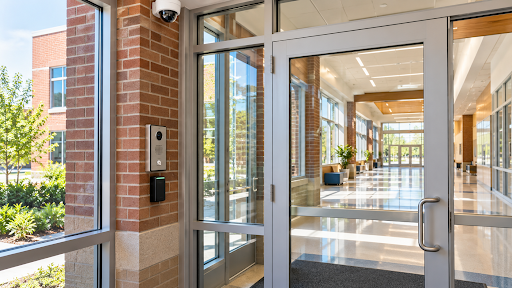
Effective school security starts with controlled entry, appropriate classroom door hardware and clear emergency communication. Cameras, access control and alarm systems should support a coordinated plan that staff understand and can use during the school day and after hours.
Requirements vary by state, school type and building. This guide covers key planning considerations for school security systems in New Jersey, New York and Pennsylvania, including entry management, emergency response and project budgeting. For the service overview, see our school and education security page.
School Panic Alarm Requirements
Panic alarm requirements should be reviewed before equipment is selected. The rules for public schools may differ from those for private or parochial schools. Confirm the requirements for your building with the relevant education authorities and local officials.
| State | Where it stands |
|---|---|
| New Jersey | Alyssa’s Law, P.L.2019 c.33, approved February 2019, requires every public elementary and secondary school building to have at least one panic alarm for a school security emergency. The statute describes a silent, manually activated signal linked directly to local law enforcement, not audible inside the building, meeting recognized industry standards and installed by a licensed alarm business. A state-approved alternative emergency mechanism is permitted. The statute addresses public schools. |
| New York | New York’s Alyssa’s Law requires school safety teams to consider panic alarm systems when reviewing safety plans. This provision should not be described as a blanket installation requirement. Confirm applicable requirements before specifying a system. |
| Pennsylvania | Confirm Pennsylvania’s applicable school safety requirements and the current status of any panic alarm legislation with state education authorities and district counsel before treating a particular system as mandatory. |
School safety planning also includes staff training, required drills and routine system testing. Confirm the drill requirements that apply to your school and make sure staff can operate the equipment as intended.
Control Access at the Main Entrance
A controlled main entrance helps staff screen visitors before they reach classroom corridors. Where the building allows, a secure vestibule creates a separate entry area with an inner door controlled by the office. The design should support visitor screening while meeting accessibility and emergency exit requirements.
- Video intercom at the exterior door so the office sees and speaks to the visitor before anything unlocks. Our guide to commercial video intercom systems covers how these are specified.
- A transaction window or pass through so deliveries and dropped off lunches never require opening the inner door at all.
- Visitor processing inside the vestibule, with identification checked and a badge issued before the inner door releases.
- Credentialed staff entry on a separate reader, so staff arriving early are not a reason to prop a door.
An entrance assessment can determine whether a secure vestibule is practical in an existing building. Construction needs, door hardware, accessibility and office sightlines all affect the design and cost.
Choose Appropriate Classroom Door Hardware
Classroom door hardware should support the school’s emergency plan while allowing occupants to leave safely. Review proposed locks and any additional security devices with the door hardware provider and local code official before purchasing.
Devices that obstruct a door can create concerns about emergency exit, accessibility and responder access. Requirements depend on the applicable codes and approved hardware arrangement, so a product should not be selected on price or security claims alone.
Discuss hardware that allows staff to secure a classroom without entering the corridor while maintaining the required means of exit. Confirm the complete arrangement with your door hardware and electronic locks provider and your local code official before buying anything.
| Review Your School Security Priorities Discuss your entrance, classroom hardware and emergency communication needs with SEH Security. Call 732-506-2260 or schedule a school walkthrough. |
Define Lockdown Activation and Response
Define who is authorized to initiate a lockdown, how they activate it and how the signal is received. Depending on the approved plan, fixed panic buttons or wearable devices may support staff in different parts of the building. Equipment selection should follow these procedures.
Second, what actually happens on activation? A well designed sequence might lock exterior doors at once, announce over the public address and intercom system, notify staff on whatever device they carry, bookmark video at the triggering location, and send the signal to law enforcement. Each of those is a decision to make in advance, not something the equipment does by default.
Coordinate Fire Alarms and Lockdown Procedures
Fire alarm and lockdown procedures must be coordinated during system design. Depending on the door hardware and approved configuration, fire alarm activation may affect electronic locking. The response must preserve required emergency exit and comply with the school’s approved safety plan.
Review system behavior with the fire alarm contractor, security installer, school leadership and local fire and code officials. Document the approved sequence, test the relevant integrations and train staff on the resulting procedures.
Plan Camera Coverage and Protect Privacy
Camera placement in a school follows the same logic as any building, with an important addition. Cover the entrances and the approach to them, the corridors and stairwells, the parking areas and bus loading zone, the cafeteria and gym, and the exterior perimeter. Pay particular attention to the entrance camera being mounted low enough to capture a face rather than the top of a head.
Camera placement must respect privacy and applicable policy. Exclude restrooms and changing areas from routine surveillance coverage, and review sensitive spaces such as counseling and health offices with district counsel. Address audio recording separately. A written policy should define authorized viewers, retention, incident preservation and procedures for footage requests.
Assign responsibility for reviewing camera alerts and responding to incidents. Recorded footage supports investigations, while a defined monitoring process may help staff assess events as they occur. Ask about remote video monitoring for after hours and holidays when the building is empty. For guidance on sizing the camera system itself, see our commercial camera system guide.
Coordinate Supporting Security and Communication Systems
School security depends on several systems working together. Review integration and compatibility across:
- Access control on exterior doors, interior zones and after hours community use of the gym or auditorium. See our access control and keyless entry page.
- Intercom and public address for classroom to office communication, bells and tones, and emergency announcements, ideally one system rather than three.
- Two way radios for staff who are rarely at a desk, which means custodial, athletics and administration. Whether radios can be patched into announcements is worth asking.
- Vehicle and parking control where the site warrants it, including license plate recognition at an entrance lane.
- Network and cabling underneath all of it. A school adding cameras, readers and access points at once needs the cabling and switch capacity planned as one project.
Budgeting and Procurement for School Security
Public district projects may involve bid requirements, board approval, funding conditions and labor rules. Define the scope clearly enough for comparable proposals and allow time for the applicable approval process.
Private and parochial schools may follow different purchasing processes. Charter schools should confirm the procurement obligations that apply to their structure and funding. For any school, prioritize work based on the site assessment, applicable requirements and available budget. A phased plan can spread costs while addressing the most urgent needs first.
Build a Practical School Security Plan
Begin with a building assessment and the requirements that apply to your school. Review entry control, classroom hardware, emergency communication and camera coverage together. Assign responsibilities, document procedures and include training and maintenance in the budget so the system remains usable after installation.
SEH Security designs and installs security systems for schools and campuses across New Jersey, New York and Pennsylvania. See how we work for what a project looks like from walkthrough to training.
Frequently Asked Questions
What security systems do schools need?
Common components include controlled visitor entry, appropriate classroom locks, security cameras, emergency communication and a defined method for initiating emergency alerts. The final scope depends on the building assessment and applicable requirements. New Jersey public elementary and secondary school buildings must have a panic alarm or approved alternative emergency mechanism.
Does New Jersey require panic alarms in schools?
Yes. New Jersey’s Alyssa’s Law, approved in February 2019, requires every public elementary and secondary school building to have at least one panic alarm for use in a school security emergency, described as a silent signal linked directly to local law enforcement and not audible inside the building, installed by a licensed alarm business. A state-approved alternative emergency mechanism is permitted. Confirm the current requirements with the Department of Education, as this area continues to be legislated.
Are classroom barricade devices allowed?
Some barricade devices may interfere with emergency exit, accessibility or responder access. Whether a device is permitted depends on the applicable codes and approved installation. Have your local code official review proposed hardware before purchasing or installing it.
How much does a school security system cost?
Costs depend on the number of controlled entrances, existing door hardware, classroom requirements, camera coverage, cabling and integrations. Request an itemized proposal that includes installation, programming, permits, training and ongoing service costs. A phased scope can help align the project with available funding.
This article is general guidance, not legal or code advice. School security statutes, life safety and accessibility codes, and panic alarm requirements vary by state and municipality, change over time, and are enforced by your local authority having jurisdiction. Verify current requirements with your state department of education, your local code and fire officials, and your district’s counsel before relying on them.
| Discuss Your School Security Project Contact SEH Security to review your building’s security needs and discuss a phased installation plan. Call 732-506-2260 or request a school security walkthrough. |

